


Leak Investigation - how we at FITnFIX trace and access hidden leaks behind tiles, under timber and concrete floors.
If you think about what a plumber does typically repairing leaks would be one of the first things that would come to mind. At FITnFIX we carry out leak investigations and repairs daily for our local customers in Bromley and surrounding areas, and have encountered every type of leak from weeping corroded mains pipes in concrete to poorly joined leaking toilet waste connectors. On this page I will outline our methods and what you can expect typically from a plumber when it comes to trace and access leak detection.
Leak Investigation Equipment
The first and most important piece of "equipment" is your plumber's eye, their knowledge and experience. In fact we find most of leaks for our clients in mere minutes just by knowing the typical signs and leak prone areas. With this regard it is important to locate a local plumber (Google maps is best as it will show you actual local businesses not just paid ADs) who advertises leak investigations and has good online feedback for this type of service.
If the leak is a little more tricky to find then our go to leak detection equipment kit contains snake camera, pressure tester, moisture meter and infrared thermal imaging camera. Quick overview of each with their pros and cons below:
Snake leak detection camera

Essential piece of equipment for detecting leaks in hard to reach or hidden areas. Examples of where cameras come in handy are bathrooms with tiled in bath panels, tiled in toilet cisterns, back to wall toilets, concealed shower valves in stud walls, timber floors, walls and ceilings, boxed in pipework.
PROS: Disruption is minimised.
Photographic and video evidence of leak easily produced, crucial for trace and access process. Waterproof.
CONS:
Needs high operator skill as camera can be very difficult to manoeuvre.
Some holes in tiles / walls etc need to be made to work the camera into the correct position.

Infrared thermal imaging camera
Possibly the last piece of equipment to come out of the bag as it only works in very niche circumstances. Thermal camera can tell if a section of your wall, ceiling, floor is colder than the rest. Any surface and material i.e concrete, tile, plaster, timber that hold moisture due to a leak from a pipe for example will always be colder but this is not noticeable to touch. However by then you will likely be able to tell this with your eyes as leaks leave mould, flaky paint, blown tiles and MDF skirting boards.
PROS:
Zero disruption.
Photographic evidence of leak.
Quick set up.
CONS:
Does not have X Ray mode! It will show up a damp patch but likely nothing more to help acertain the leak source.
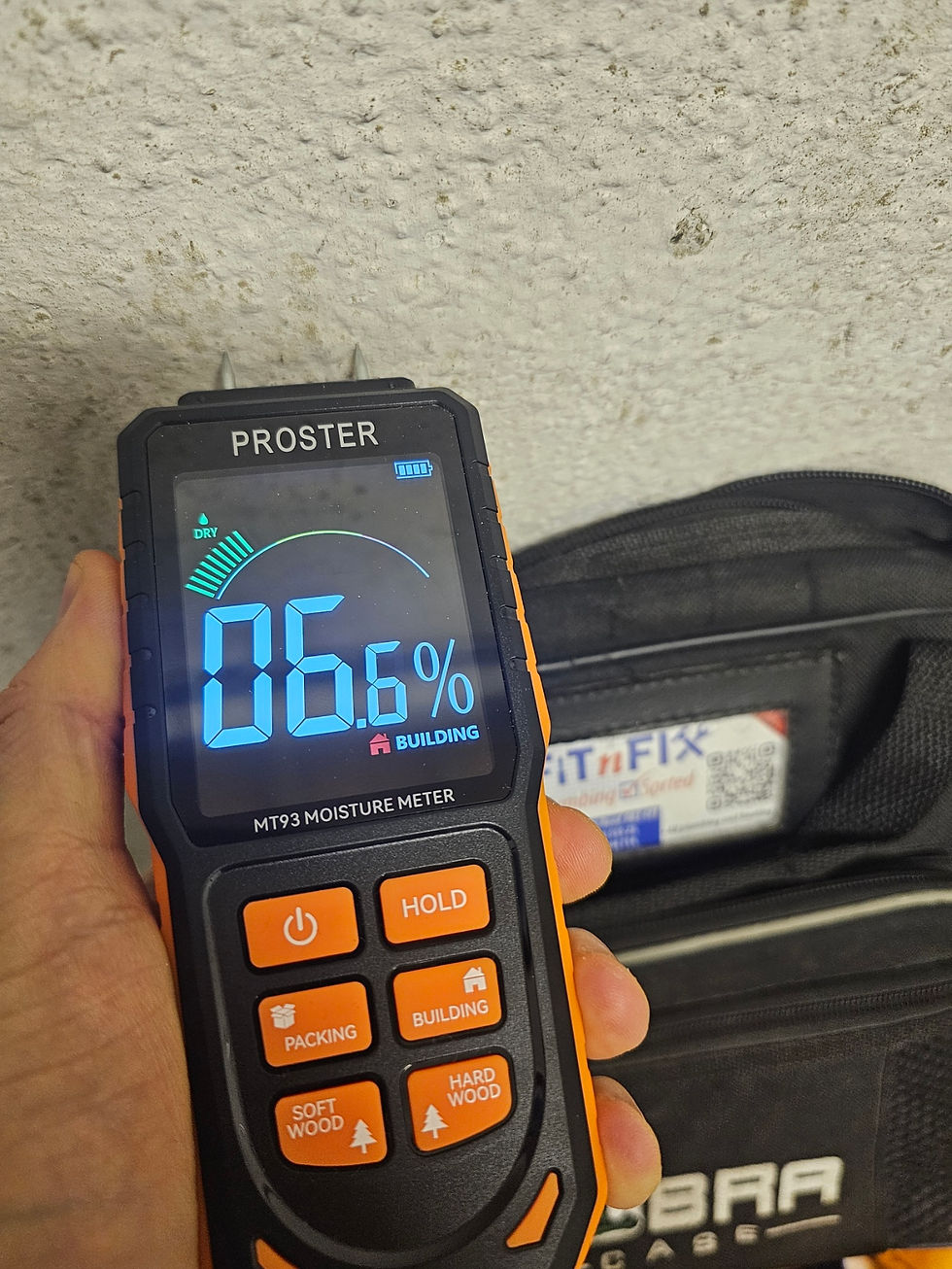
Moisture meter
Just like the thermal camera this has limited practical applications. Where is excels is showing exact moisture content in a precise location. This allows us to pinpoint the highest concentrated levels and "mark the spot" where potential leak source i.e leaking pipe or valve is located exactly.
PROS:
Minimal disruption.
Pinpoint accuracy.
Quick set up, DIY friendly.
Ongoing moisture measurements help prove the leak is stopped.
CONS:
Does not have X Ray mode! Same as the infrared camera we can only detect surface moisture you can already likely see. This can only guide us further to the leak source but not outright locate it.

Water pressure gauge
This is one of my favourites. Your water system will comprise of many separate water circuits i.e hot, cold, gravity copper pipe, mains, outside lead main supply, upstairs feed etc. With some clever isolation of circuits you can quickly establish exactly what system is leaking.
PROS:
Allows to identify leaking circuit, this can be isolated to immediately stop your leak.
CONS:
Set up can involve cutting in new valves in your pipes.
Who to call when you have a hidden leak and require a leak investigation?
Before we wrap up it is very important to note that leak investigation methods will vary from plumber to plumber but in general there is a noticeable distinction between a leak investigation from a plumbing company vs a leak detection specialist company.
Companies that specialise in leak detection usually do not repair leaks (they may use a contractor to do so), while they utilise all methods listed below they will also be able to employ highly specialist equipment such a trace gas leak detection. Both are suitable for trace and access process. The main caveat here is these specialist charge up to 10 times more than a plumber typically would. Therefore seeking a leak detection specialist right away is not advisable as your leak very likely can be found by much more available and reasonably priced local Bromley plumber. Speaking of which our leak detection and repair services are very accessible and do not carry additional fees over our standard £80+VAT per hour rate. You can book directly a leak investigation booking for your property into our diary we have a dedicated "Leak investigation" service there. Also worth mentioning we work directly with your insurance companies where applicable provide them with trace and access documentation necessary for any claim. We can also offer in house making good services (you can check out this post about one of our Bromley leak repairs with making good the ceiling) to put your ceiling or tiling back to it's original pre-leak state. Whatever you do do not let the first signs of leaks go unnoticed as they can turn a small repair done early into a small repair plus a big renovation project to put right the damaged surfaces.


The detailed fantasy stage settings and character-specific designs give each page a unique challenge, which is great for older kids or teens who want more intricate coloring. The option to color online without registration is a nice convenience when you're traveling or short on printing supplies. check the demon hunter themed lineup for a fresh take on character-based coloring activities.
Upon reflection, the reasoning does not extend beyond the available facts. Methodological choices are explained and justified clearly. The website contributes important background to the discussion. Adoption trajectories are illustrated through platform-based media ecosystems.